
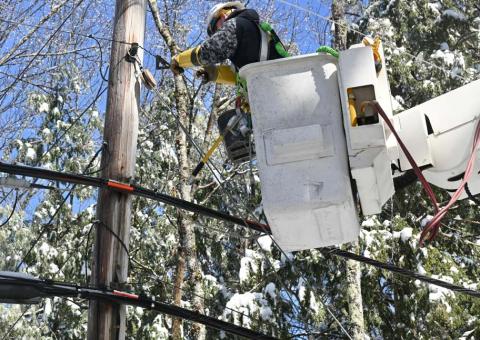
When the power goes out, most people understandably begin to wonder how long it will take to get the lights back on.
It’s an obvious question from any utility customer who’s in the dark, but providing an immediate answer can sometimes be challenging, especially when a strong, long-duration storm strikes and damage is widespread.
With the winter season approaching and the potential for storms to create hazardous conditions that could lead to power outages, Unitil is highlighting the important role that damage assessment plays when it comes to estimating when power will be restored to impacted areas.
A comprehensive assessment of damage to the system is crucial to any restoration effort, which is why a team of damage assessors is deployed to get a first-hand, up-close look in the aftermath of a significant weather event.
“It’s really difficult for us to know the full extent of the damage until we have an opportunity to get out into the field to see what the situation really looks like,” said Unitil External Affairs Manager Amanda Vicinanzo. “That damage assessment is critical for us to understand exactly what we’re dealing with. We understand it can be frustrating for customers when they check the Unitil Outage Map looking for an estimated time of restoration only to see that it says ‘assessing,’ but that additional information is necessary in order for us to better estimate when power will be restored.”
Unitil must wait until the hazardous conditions created by a storm end and the potential for new outages is limited before estimating how long it will take to restore power to all customers. Assessing damage can sometimes be a lengthy process that begins with assessors being dispatched to areas experiencing outages to survey problem areas. Meanwhile, crews continue to restore power and work with first responders in parallel with the damage assessment process. Important details about the total reported damage help to establish accurate estimated times of power restoration for customers.
With a clear picture of system conditions available, Unitil can then compare the number of crews available with how many hours it may take to complete each job. After the calculation is made, the company is able to provide a global estimate of when power should be restored. The information is then shared with customers and estimated times of restoration (ETRs) are added to the Unitil Outage Map.
A complete damage assessment is used to prioritize the restoration process as well as give crews a better understanding of the specific locations so that they know which specialized tools and supplies may be needed before arriving.
“As we work to restore power as quickly and safely as possible, it’s important to remember that damage assessors often encounter challenging conditions when trying to access areas with significant damage. In addition to road closures due to damage, they could face limbs on wires, broken utility poles, downed trees and wires and other problems,” Vicinanzo said. “Damage-assessment tools not only keep our outage map updated with the restoration details customers rely on for planning, they also help us identify ways that enable our teams to work more efficiently and effectively.”
